Instantaneous Power
As in DC circuits, the instantaneous electric power in an AC circuit is given by P=VI where V and I are the instantaneous voltage and current.
Since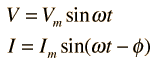 | 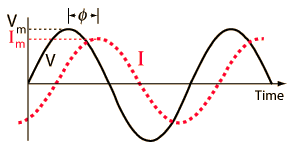 |

and using the trig identity

the power becomes:

Averaging this power over a complete cycle gives the average power.
Average Power
Normally the average power is the power of interest in AC circuits. Since the expression for theinstantaneous power
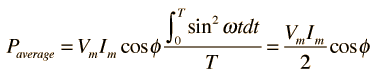
is a continuously varying one with time, the average must be obtained by integration. Averaging over one period T of the sinusoidal function will give the average power. The second term in the power expression above averages to zero since it is an odd function of t. The average of the first term is given by
 |
|
| Since the rms voltage and current are given by |  | and |  , , |
the average power can be expressed as
True, Reactive, and Apparent Power
Chapter 11 - Power Factor
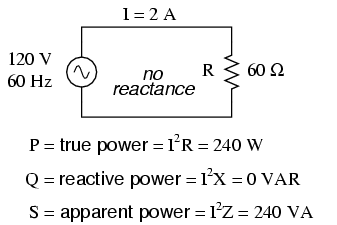
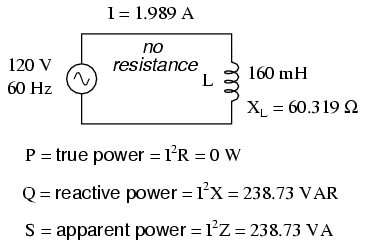
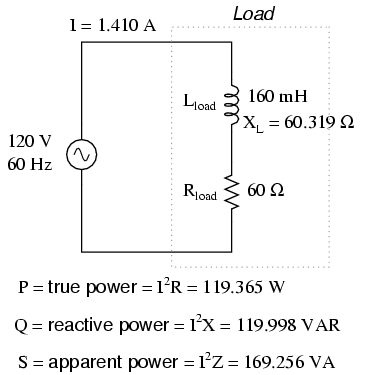
We know that reactive loads such as inductors and capacitors dissipate zero power, yet the fact that they drop voltage and draw current gives the deceptive impression that they actually do dissipate power. This “phantom power” is called reactive power, and it is measured in a unit called Volt-Amps-Reactive (VAR), rather than watts. The mathematical symbol for reactive power is (unfortunately) the capital letter Q. The actual amount of power being used, or dissipated, in a circuit is called true power, and it is measured in watts (symbolized by the capital letter P, as always). The combination of reactive power and true power is called apparent power, and it is the product of a circuit’s voltage and current, without reference to phase angle. Apparent power is measured in the unit of Volt-Amps (VA) and is symbolized by the capital letter S.
As a rule, true power is a function of a circuit’s dissipative elements, usually resistances (R). Reactive power is a function of a circuit’s reactance (X). Apparent power is a function of a circuit’s total impedance (Z). Since we’re dealing with scalar quantities for power calculation, any complex starting quantities such as voltage, current, and impedance must be represented by their polar magnitudes, not by real or imaginary rectangular components. For instance, if I’m calculating true power from current and resistance, I must use the polar magnitude for current, and not merely the “real” or “imaginary” portion of the current. If I’m calculating apparent power from voltage and impedance, both of these formerly complex quantities must be reduced to their polar magnitudes for the scalar arithmetic.
There are several power equations relating the three types of power to resistance, reactance, and impedance (all using scalar quantities):
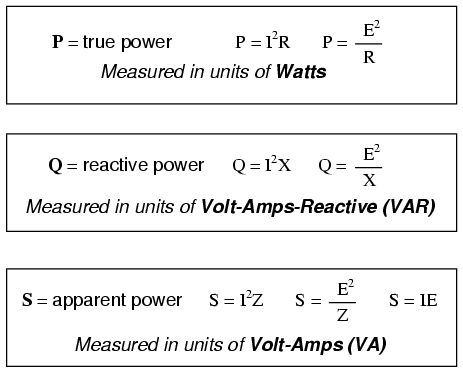
there are two equations each for the calculation of true and reactive power. There are three equations available for the calculation of apparent power, P=IE being useful only for that purpose. Examine the following circuits and see how these three types of power interrelate for: a purely resistive load in Figure below,
a purely reactive load in Figure below,
and a resistive/reactive load in Figure below.
a purely reactive load in Figure below,
and a resistive/reactive load in Figure below.
Resistive load only:
Reactive load only:
Resistive/reactive load:
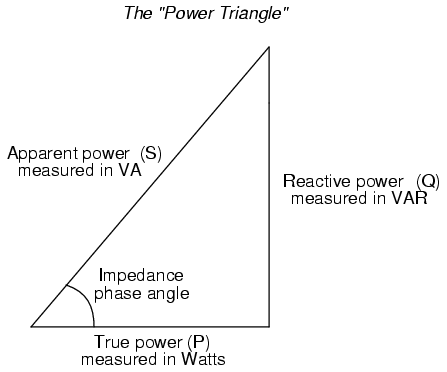
These three types of power—true, reactive, and apparent—relate to one another in trigonometric form. We call this the power triangle: Figure 1 .


No comments:
Post a Comment